Wrapping up EPF6 (EthCC ➡️ Devconnect)


🇰🇷한글 버전: Link
Year 2025 must be a really meaningful year for me.
My experience participating in and completing the sixth cohort of the EPF (Ethereum Protocol Fellowship) takes up a pretty significant portion of that. This post is a retrospective article on the past six months and hopefully something helpful for those who want to become an EPF Fellow in the future.
What is EPF?
It stands for Ethereum Protocol Fellowship, a program run directly by the Ethereum Foundation. If you ask core developers how they got into core development, you'll hear a thousand different reasons and paths, but EPF has its own system and reputation within the ecosystem, which is a huge help for onboarding new core developers. The sixth cohort has just wrapped up.
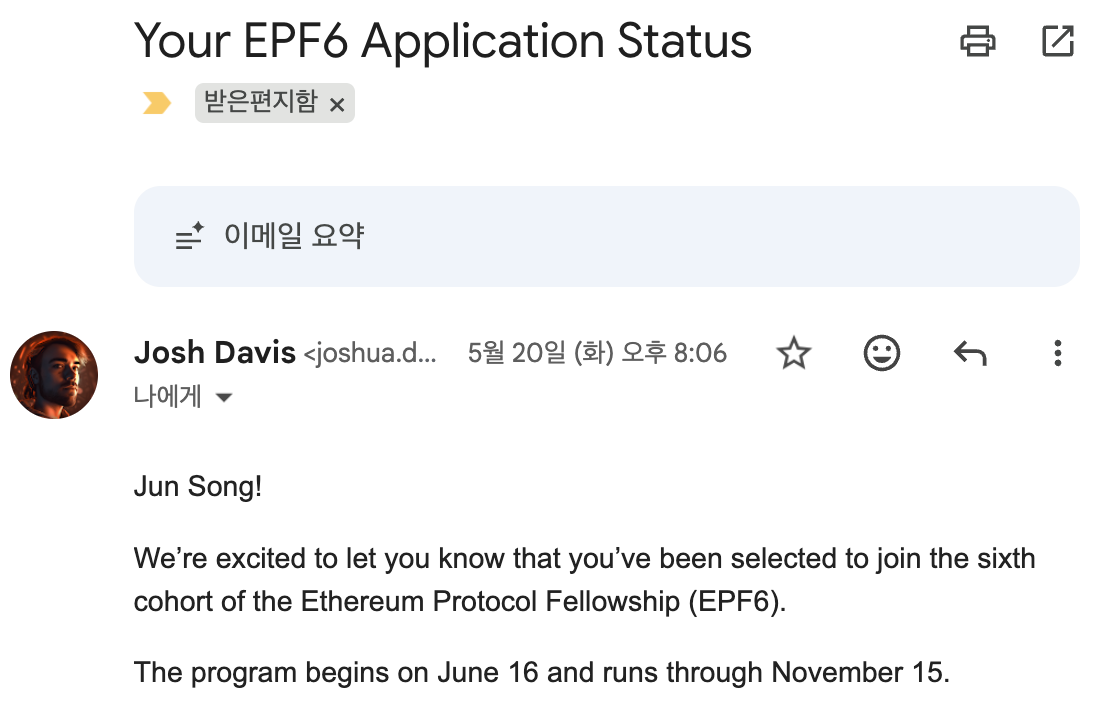
For this cohort, fellow recruitment started in April 2025, and the results (acceptance/rejection) were decided on May 20th. Even if you're not accepted, EPF itself is open to everyone, so you can still participate in a "Permissionless" way if you want. The difference between Permissioned and Permissionless Fellows doesn't seem to be big, other than the financial support (Monthly stipend, expenses for EthCC & Devcon(nect)). There were quite a few cases where people started Permissionless but then showed decent performance during the period and were converted to Permissioned status to receive support. (What constitutes "decent" is pretty subjective, but it seems to involve a comprehensive evaluation by the organizers and mentors.)
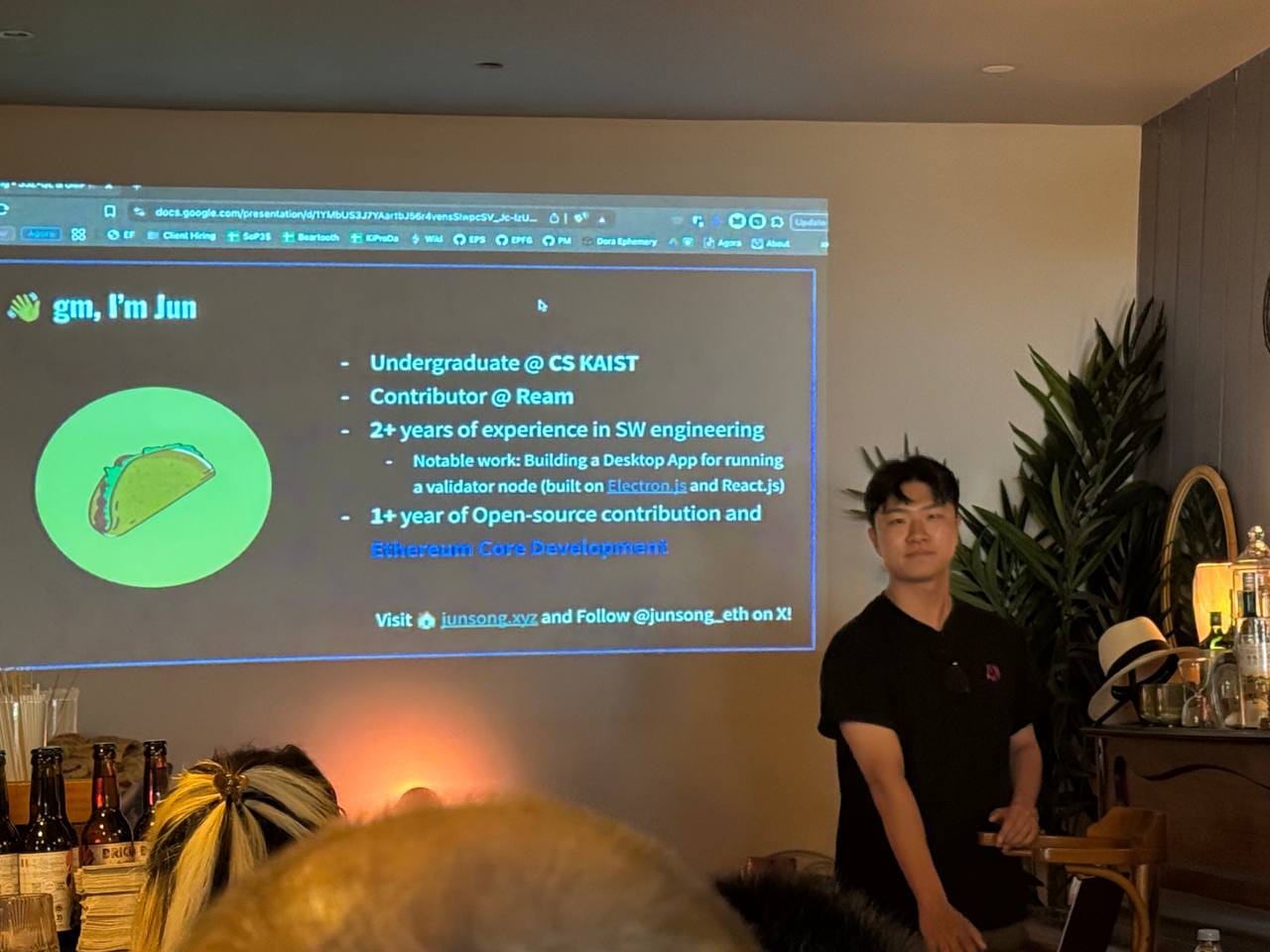
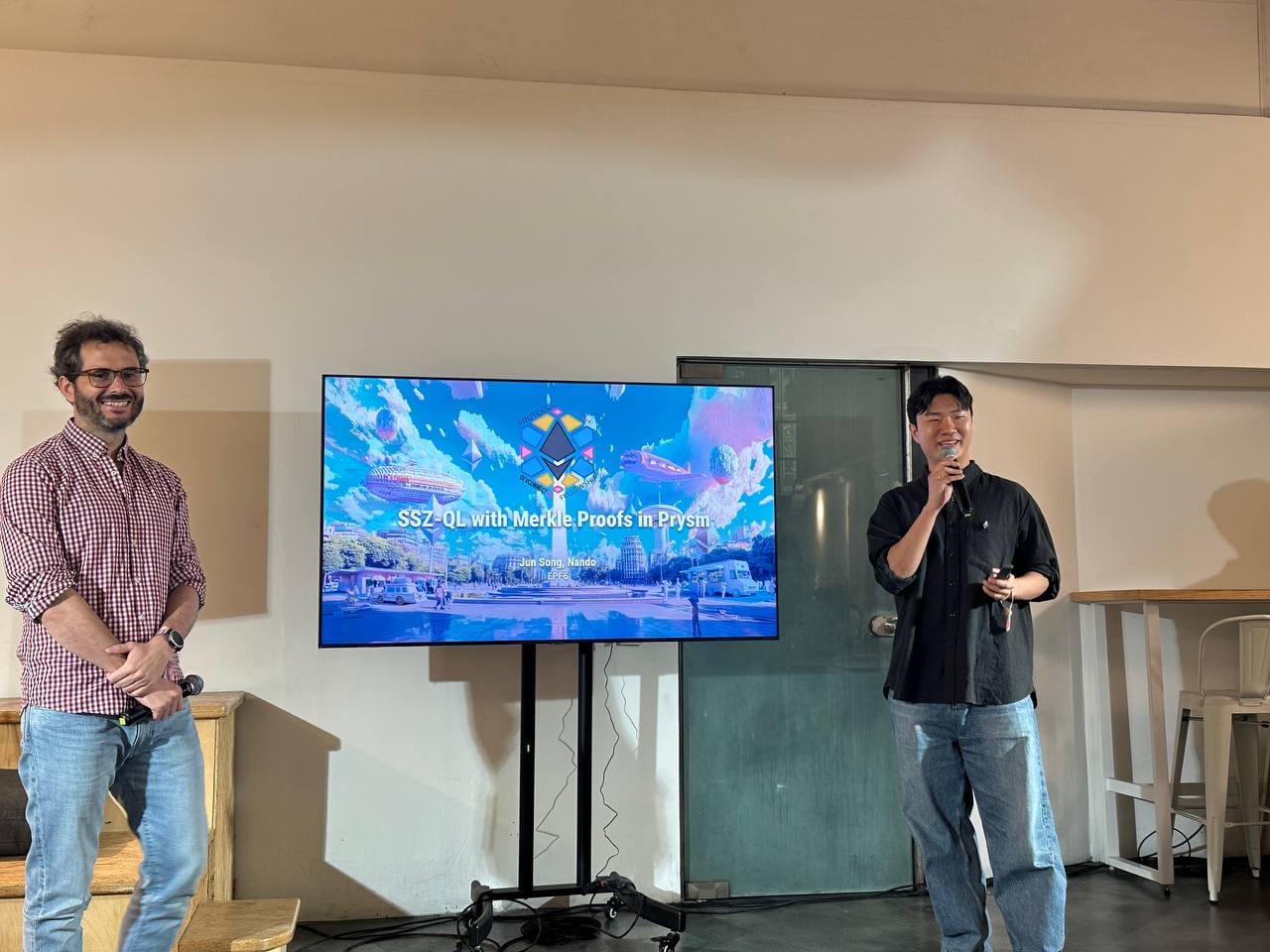
We had our first offline meeting at EthCC, held in Cannes, France, this June. There, we presented our proposals for the projects we would contribute to over the next 20 weeks. After that, we proceeded with the projects while sharing weekly updates. Updates are done by sharing documents (we mostly use HackMD) and also by briefing our progress during a weekly Standup Call. We met offline for the second and final time at the recently concluded Devconnect, where we presented our project results. (EPF Day @ Devconnect Live Stream)
Once EPF finishes, the Fellows go their separate ways. EPF acts as a sort of showcase or a gateway; if you show decent results here compared to others, it seems to become much easier to enter the core development ecosystem in the future. There have been quite a few success stories from previous cohorts as well.
Below are the resources related to this year's EPF:
- Announcement of EPF6: https://blog.ethereum.org/2025/04/10/epf-6
- EPF6 Github Repo: https://github.com/eth-protocol-fellows/cohort-six
- Weekly Development Updates: https://github.com/eth-protocol-fellows/cohort-six/blob/master/development-updates.md
- EPF Day @ Cannes: https://youtu.be/UqkQdlyEwdA?si=nIxeSLGacdxJBdre
- EPF Day @ Buenos Aires: https://www.youtube.com/live/1ZktKW1NBz0?si=3UKKPGFypjmE3iy7
- My outcomes:
- Project Proposal: https://github.com/eth-protocol-fellows/cohort-six/blob/master/projects/ssz-ql-with-merkle-proofs.md
- Weekly Updates & Write-ups: https://hackmd.io/@junsong/SkB51ZR1be
- Final Report, Slides - Final Talk Recording (Available soon or Check out the live stream)
Personal Thoughts...
Self-motivation
EPF doesn't enforce anything during the fellowship period. Sharing weekly updates is a recommendation, and there's no explicit penalty even if you don't properly finish your project. Since core developers generally have strong convictions and the work isn't something they receive from management, this approach seems to fit the purpose. Most Fellows who produced good results during the fellowship were those who proactively found their own tasks and consistently executed them.
Although mentoring from core developers and EF researchers is included, 1) they have limited resources, and 2) over 99% of communication happens asynchronously and online, so real-time feedback is hard to expect. Project topics are suggested by each team, but no one spoon-feeds you the plan, so the A to Z (from planning to execution) is entirely up to the Fellow—this is also mentioned in the EPF description. I was lucky that Radek from Prysm actively reviewed my PRs during the fellowship, and I received many valuable comments.
Documentation & Code

Continuing from the mentoring point above, most communication takes place online. You could schedule a real-time call, but text communication via Discord or Telegram is more frequent because it is often more efficient. In my case, I communicated quite efficiently without a single online call during the fellowship, exchanging over 400 messages in one Discord thread.
Context switching is frequent, and the context itself is often lost due to the nature of asynchronous communication. The most efficient way to communicate (in my opinion) was to first create the code, either in the form of a well-organized document or a PR, and then forward the link via message. My project(SSZ-QL) was a new idea that didn't exist before, so understanding the feasibility of the implementation direction was crucial. Directly creating and showing a PoC(Proof of Concept) during this process seemed to save a lot of communication overhead.
Overall Experience as a Fellow
I participated in two events during the fellowship period, and having an "affiliation" was simply great. People at the EF and those involved in core development are well aware of EPF's existence, and some are even EPF alumni, which was a huge help in starting conversations.
Fellows in the cohort were able to meet offline at least once, and we met online every week to discuss various topics (Breakout rooms). It was great that we could quickly become close friends since we all shared similar goals despite having different backgrounds. I feel like I've gained friends I can grab a meal with anywhere in the world now.
Thanks to Mario and Josh, who run EPF, I've had many unforgettable experiences this year. I'd like to take this opportunity to express my gratitude.
What's Next? & Conclusion
There's still a bit of work left for my project, SSZ-QL. The nearest milestone is to finish the Merkle Proof generation logic with my teammate Nando and officially propose it to the beacon-APIs.
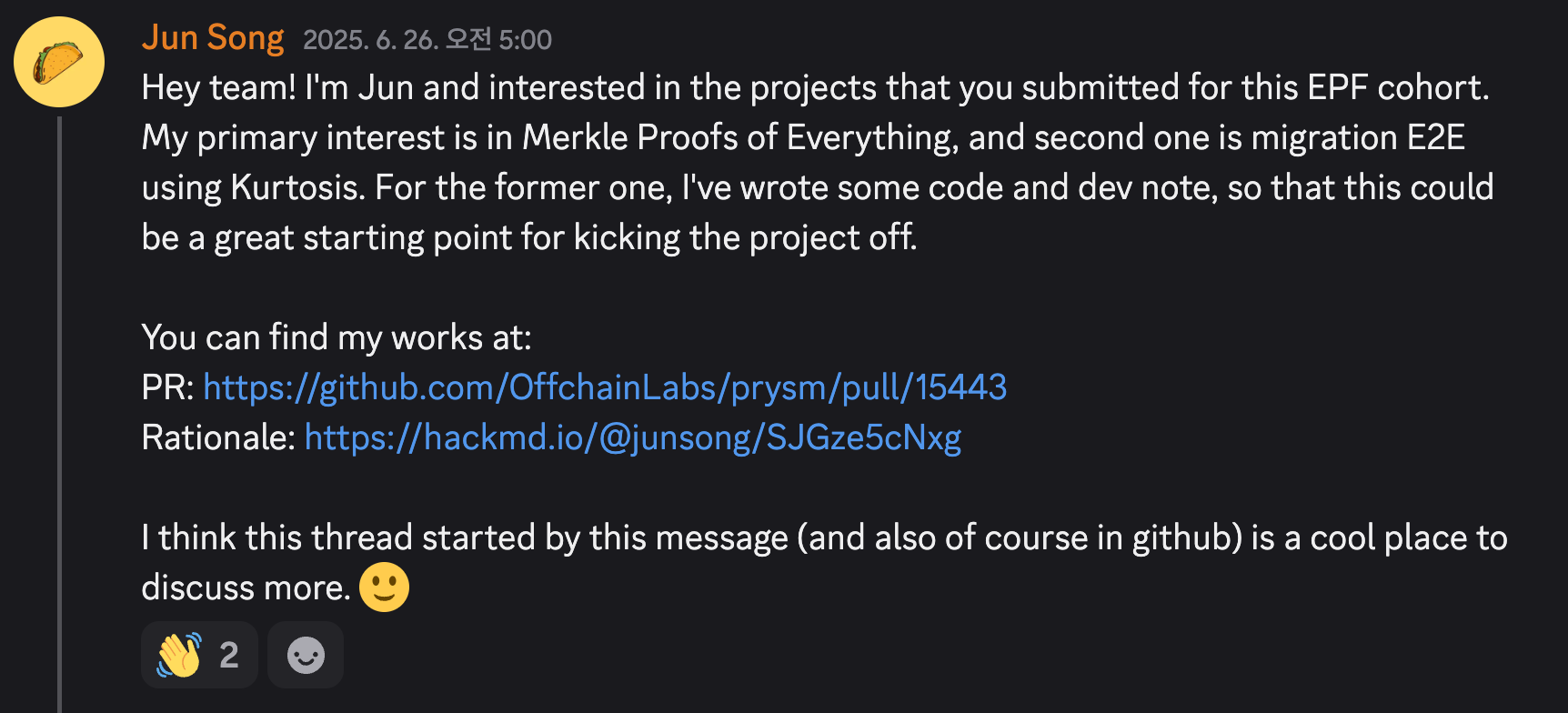
When deciding on a topic at the start of EPF, I was also interested in migrating Prysm's E2E test package using Kurtosis & Assertoor. Since I had a good experience collaborating with the Prysm team (e.g., solving the P2P Sequence Number issue), I want to keep that momentum up. I'm planning to have a kick-off meeting for the next project soon.
Ethereum core development is an attractive field in many ways, but it can be hard to get into. EPF doesn't give one single answer about the core development itself, but at least can point you in the right direction. If anyone is interested in the fellowship itself or is heading toward core development, please feel free to contact me!