An (Early) 2026 H1 Retrospect


🇰🇷 Korean version: https://junsong.xyz/ko/2026-h1
It's still a bit early to be wrapping up the first half of the year, but this feels like a good spot to pause and put down a comma, so I'm writing a quick retrospective. I spent most of this year in New York and came back to Korea not long ago. This one is mostly about my time there.
You can find my past retrospectives here.
NYU
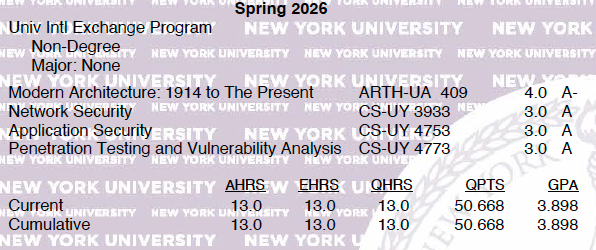
Through the NYU minor program that KAIST offers, I spent a semester taking classes at NYU's Tandon School. The overall difficulty was pretty manageable - the courses I'd taken back in KAIST's CS (Introduction to Information Security, Introduction to Computer Networks, and so on) turned out to be a huge help. On top of cybersecurity, I also took Modern Architecture and picked up a little culture along the way.
The class I found most interesting was LLM Security. It was originally a fearsome-sounding course called Penetration Testing and Vulnerability Analysis, but it had been updated to reflect the latest trends, so we got to learn things like the LLM OWASP Top 10. Turns out there are a lot of tools for learning this stuff interactively, like LLMGoat and Gandalf. The assignments were mostly about prompt injection, and there was something fun about wrestling with the LLM to crack them.
Auditing Classes at Stern
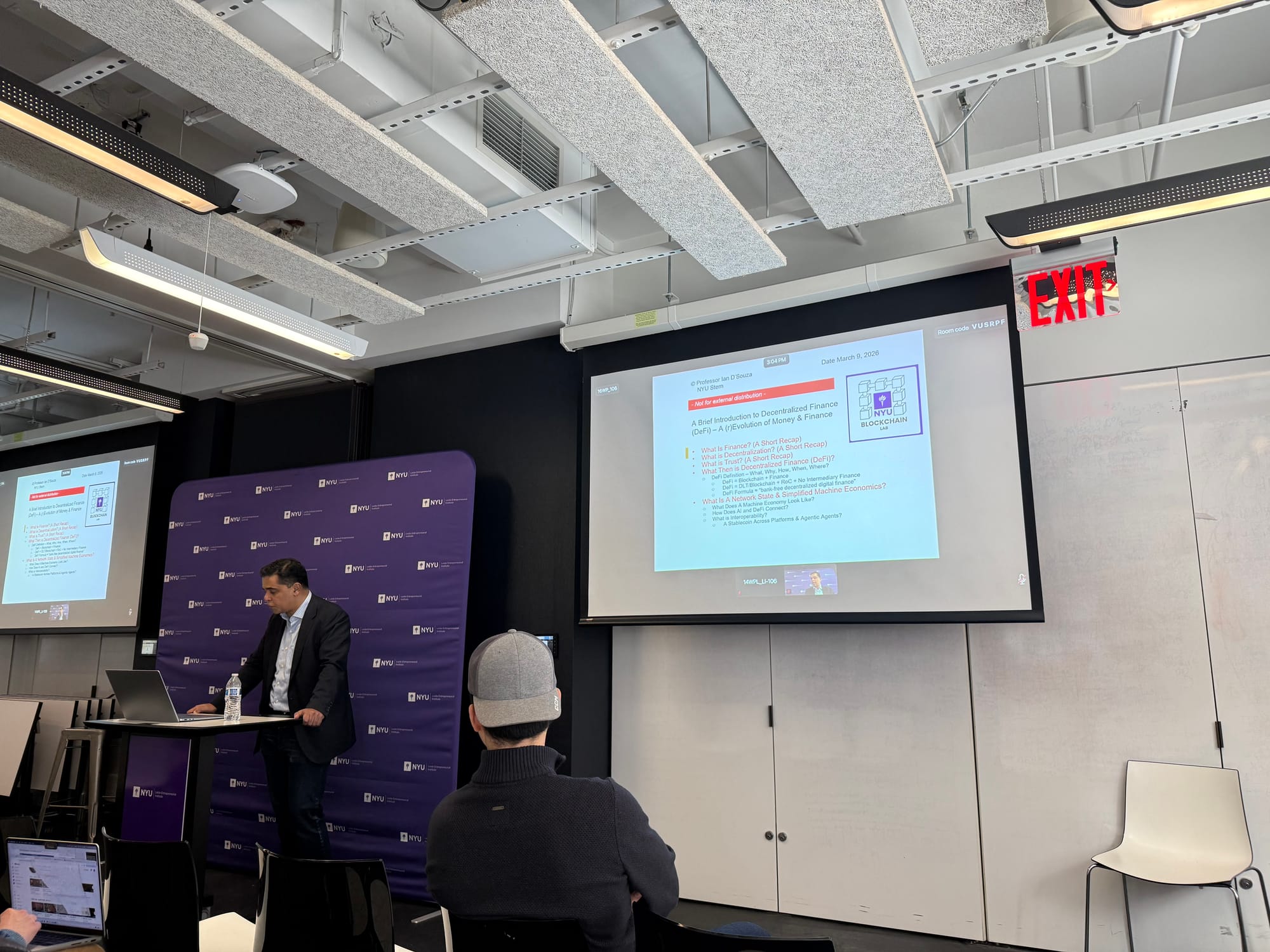
NYU has a student-run club called the NYU Blockchain Lab. They host a talk every week, and in March I got to meet Ian D'Souza, a Clinical Professor at NYU Stern. I was drawn in by his teaching and his sharpness, and as we got talking I learned he was running two graduate courses at Stern this semester - one on digital currencies and blockchain, the other entirely on DeFi.
Since I was in Tandon I couldn't actually register, but he said I was welcome to audit anytime, so I sat in on his classes several times - and it ended up being one of the best things I did while at NYU. I think of myself as an engineer, and especially over the past few years I've been working at the core level, so I'd always wanted to hear from the people operating at the very top layer of the system, the ones actually putting it to use. I believe Ethereum in particular should function as financial infrastructure, which means I really needed to hear from the people currently on Wall Street. Professor D'Souza has a ton of hands-on experience and stays in constant contact with people on Wall Street and in the White House, so there was no better class for getting the view from the ground.
Right now there are only three schools in the entire US offering a full-credit course dedicated purely to DeFi: MIT, Berkeley, and NYU. The professor stressed to his students again and again that this alone is a competitive edge. I picked up so much over those classes - I'm still organizing my notes, so I'll share them in a separate post!
FOMO in AI
Like just about everyone, I've been doing my own share of intense thinking about survival (and existence) in today's fast-moving AI market. I still haven't reached any conclusions, but instead of just sitting with the FOMO, I want to be someone who treats AI tools as tools and actually puts them to good use.
Luckily I had a spare(?) MacBook lying around, so I set up OpenClaw - which was very hot in the first half of this year - and played around with it. People on X and YouTube rave about it as a life-changing tool, but whether it's that I can't squeeze 120% out of it or something else, I definitely hit limits once I tried it myself. The gateway kept getting heavier with every update and would crash a lot. I wanted to keep human intervention to a minimum, but I ended up SSH-ing in to debug it myself more than a few times. Cleaning up resources seems to matter too - useless data kept piling up day after day, and at one point it ate through all my MacBook's storage. People seem to be using Hermes Agent a lot these days as well, so I'd like to at least dip my toes in.
Another trend was agentic coding. I wanted to build a process where a human doesn't write the code directly, so I took on a small project based on Prysm, which I'd been contributing to here and there. (Write-up here.) I ran the whole thing by issuing commands over Discord to the OpenClaw instance I had going, and before kicking off the real process, I locked down a tight CI with the criteria a PR had to meet before it could be merged. This too is already a story from more than two months ago, and new development frameworks keep dropping even as I write this, so it's another area where I need to keep studying.
Random Thoughts
- It was interesting how a country's way of thinking shows up in its transportation system. There's a big gap: in the US it's basically "just don't do what you're told not to do," while in Korea it's "you can only do it where it's explicitly allowed." For example, when you see a Stop sign you have to come to a full stop no matter what, or you can make a left turn whenever you like, and so on.
- As I wrote in my last retrospective, New York is a fantastic place if you love modern art. I've been to MoMA so many times I could probably play docent if I brought someone along. Everyone picks the MET as the best, but for some reason the aura of the building itself, plus all the countless artifacts and works inside, drains me fast. The Rothko Chapel I visited in Houston is also one of the best experiences I had in the US.
- This is the longest I've ever stayed abroad. Whenever the time comes to choose to leave Korea, this semester in New York will probably be a big help. That said, New York itself doesn't seem like a great place to actually live - I felt short on personal space, and like I couldn't fully tap into this enormous web of people and connections.
Now I've just got my final undergraduate semester left. I'll be heading back to Daejeon soon. And I'm about to step into a new chapter in my career - there should be an update on LinkedIn before long!